In brief
Use height and inseam as a starting point. Check whether the model uses centimetres or S/M/L sizing. Compare reach and stack. Always verify the brand’s size chart for the exact model.
Enter height and inseam in the calculator above to get your result.
What road bike size depends on
Road bike fit depends on total height, inseam, torso length, arm length, flexibility, riding style and frame geometry. Two riders with the same height can need different sizes because body proportions vary from rider to rider.
How to estimate frame size
A common indicative formula for road bikes uses inseam:
indicative frame size = inseam × 0.67
Example: inseam 82 cm. 82 × 0.67 = 54.9 cm. Indicative frame size: about 55 cm.
This estimate can help you narrow the search, but many modern bikes use compact geometry and letter sizes such as XS, S, M, L or XL. Always compare the result with the actual model chart.
Centimetres or S/M/L sizing
Traditional road bikes were often listed in centimetres, such as 52, 54, 56 or 58. Many modern models use S, M, ML or L.
The issue is simple: an M is not the same across all brands. An endurance M may be taller and more comfortable at the front, while a race M may be longer and lower. So “I ride an M” is useful only until real geometry enters the room.
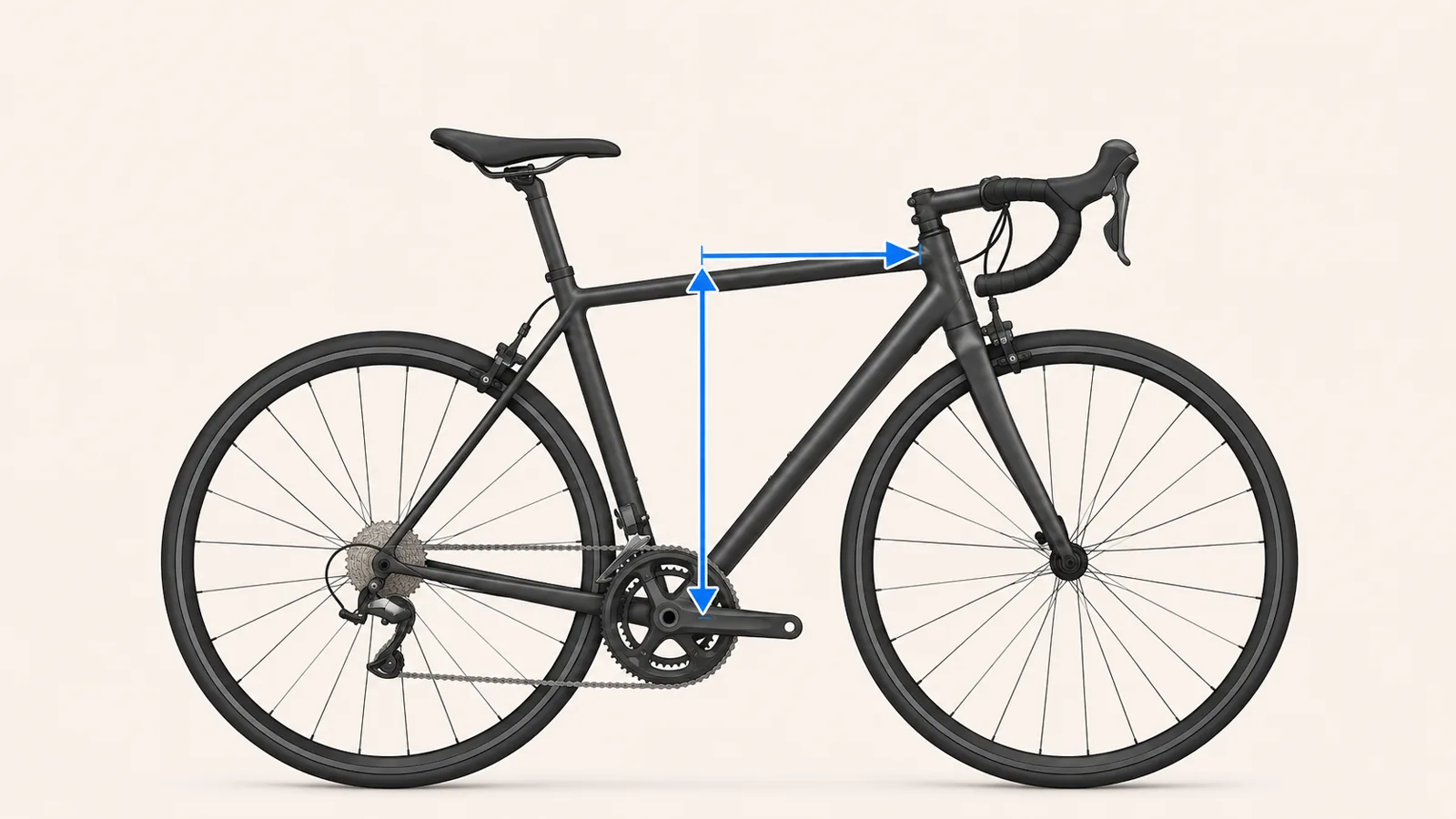
Reach and stack: why they matter
Reach shows how long the frame is toward the front. Stack shows how tall the front of the frame is.
A longer reach gives a more stretched position. A shorter reach gives a more compact position. A higher stack gives a more comfortable front end. A lower stack gives a more aggressive position.
If the nominal size looks right but reach is very long, the bike may still feel too stretched.
Practical examples by height
170 cm — typical inseam ~79 cm → indicative frame ~53 cm, often size S or S/M.
175 cm — typical inseam ~81 cm → indicative frame ~54 cm, often size M.
180 cm — typical inseam ~84 cm → indicative frame ~56 cm, often size M/L or L.
These estimates assume average proportions. A long inseam relative to height may push the result toward a larger frame; a long torso may require more reach.
Endurance vs race: how size changes
An endurance bike has higher stack and often shorter reach: comfortable position, less load on hands and back. A race bike has low stack and long reach: aerodynamic and aggressive.
At the same nominal size (e.g. 54), an endurance bike feels more "upright" while a race bike feels more "stretched". Two riders at 178 cm may fit better on different sizes if one chooses endurance and the other race.
If you try an endurance bike after riding a race bike in the same size, the higher stack may feel too relaxed. That does not mean wrong size — it means different geometry.
What to do if you are between two sizes
If you are between two sizes, think about your intended position. A smaller size often suits a sportier, more reactive setup. A larger size can suit comfort and stability.
Do not decide by theory alone. Check reach, stack, standover and the manufacturer’s chart before buying.
FAQ
How do I calculate road bike size?
Use height and inseam for an initial estimate. A common indicative formula is inseam × 0.67 for frame size in centimetres.
Is every M road bike the same?
No. Size labels change between brands and models. Geometry must be compared.
If I am between 54 and 56, which should I choose?
It depends on position, flexibility and use. A 54 may feel more agile, while a 56 may feel more stable and stretched.
Does BikeSize replace the manufacturer’s chart?
No. BikeSize helps estimate a size, but the manufacturer’s chart remains the main reference for the specific model.
Recommended internal links
Road bike size depends strongly on frame geometry and preferred position. Use the calculation as an initial orientation and always check the official manufacturer chart before buying.