In brief
Start with height and inseam. Check standover and reach. Consider the type of MTB and your riding style. Always compare the result with the geometry chart for the exact model.
Enter height and inseam in the calculator above to get your result.
Why MTB sizing is different from road bike sizing
A mountain bike is not chosen like a road bike. The riding position is different, the handlebar is wider and control over changing terrain matters a lot.
On an MTB, you need to move over the bike, handle descents, turns, obstacles and changes in gradient. Size is not only about sitting comfortably. It is also about controlling the bike when the terrain changes.
How to estimate MTB size
Use height and inseam as an initial reference. BikeSize can provide a practical estimate, but the result must be compared with the manufacturer’s chart.
Many modern MTBs use XS, S, M, L and XL instead of traditional inch sizing. This makes the geometry chart even more important.
MTB sizes: S, M, L or inches
MTBs may be labelled with letters or inches. Common examples are S, M, L, XL or 15”, 17”, 19”, 21”.
The problem is that one brand’s M may not match another brand’s M. A modern trail bike can have a much longer reach than an older MTB in the same nominal size. The label is a shortcut, not the full answer.
Reach, stack and standover
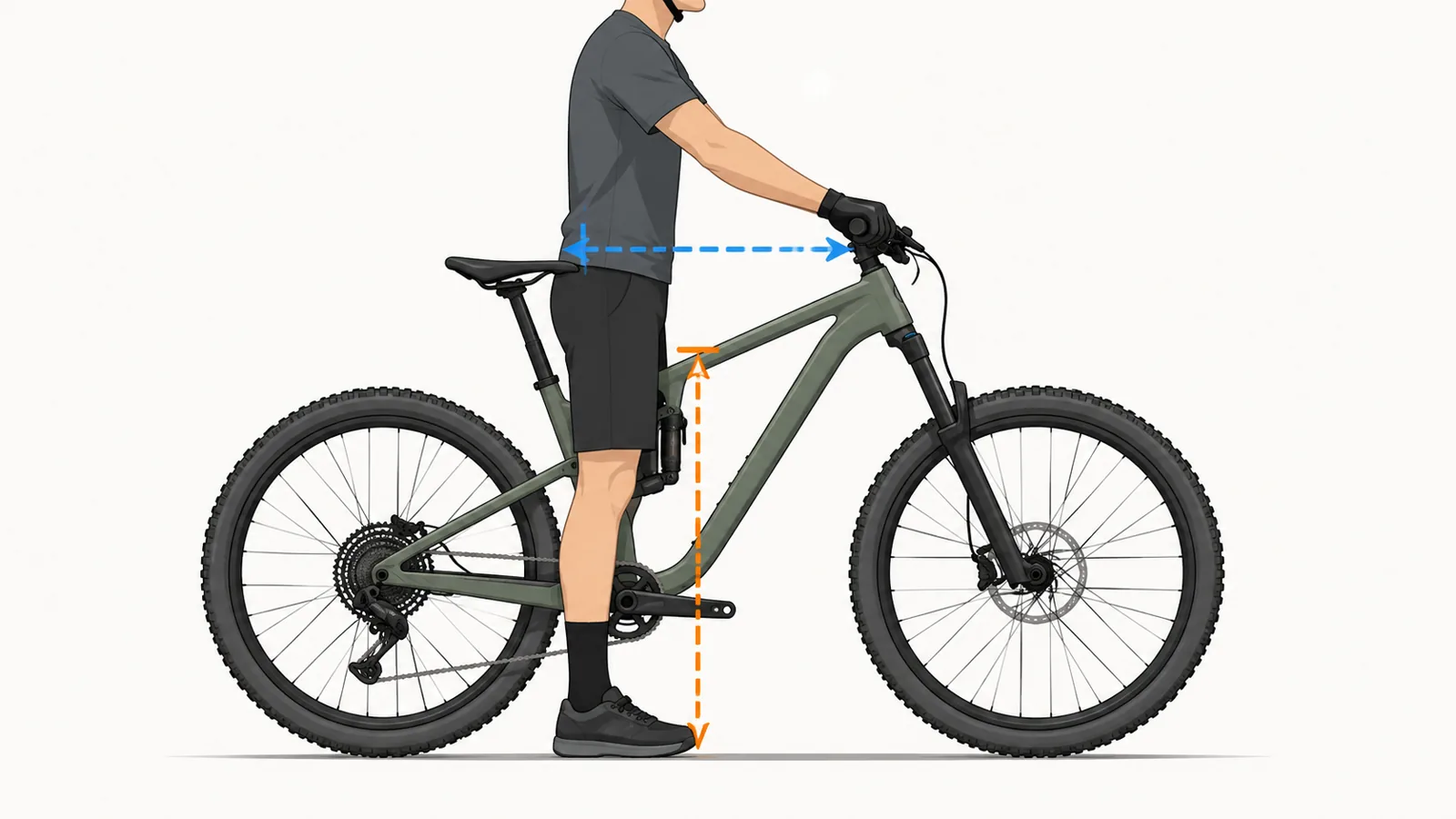
Reach tells you how long the bike feels in an active riding position. Stack tells you how high the front end is. Standover is the space between the top tube and your body when standing over the bike.
Standover matters on MTBs because you need room to move and dismount safely. A reach that is too short can make the bike nervous. A reach that is too long can make it hard to control, especially for less experienced riders.
XC, trail, enduro: how sizing changes
MTBs are not all the same. The discipline changes the geometry, and the geometry changes the right size.
- Cross-country (XC) — moderate reach, efficient pedalling position. Light frame, steeper head angle. Generous standover for agility.
- Trail — medium-long reach, balance between climbing and descending. 130–150 mm travel. Room to move above the frame matters.
- Enduro — long reach, slack head angle, 150–180 mm travel. Stable downhill, less agile in tight sections. Standover is critical because you often need to dismount quickly.
- E-MTB — heavier (20–25 kg), specific geometry. Control and standover matter even more.
A rider switching from XC to enduro at the same nominal size may feel the bike very differently: longer reach, more rearward position, less agile feel.
Standover and dropper post
Standover is the space between the top tube and your body. On MTBs it is critical: you must be able to stand, shift and dismount on technical terrain without obstruction.
A dropper post (telescopic seatpost) helps on trail and enduro by lowering the saddle on descents. But it does not compensate for a wrong frame size: if the frame is too big, a dropper does not fix poor standover.
What to do if you are between two MTB sizes
A smaller MTB usually feels more agile and easier to move around. A larger MTB usually feels more stable and stretched.
For technical riding, many riders avoid going too large. For calmer riding or fast flowing trails, a more stable size may make sense. The choice depends on experience, terrain, riding style and the model geometry.
FAQ
How do I choose MTB size?
Start with height and inseam, then compare the result with the manufacturer’s chart and check reach, stack and standover.
Is a smaller or larger MTB better?
Smaller usually feels more agile. Larger usually feels more stable. The better choice depends on riding style.
Are MTB sizes in inches still used?
Yes, but many modern brands use letter sizes such as S, M, L and XL.
Does an M MTB fit the same across all brands?
No. Geometry changes a lot between brands and models. Always check the specific chart.
Recommended internal links
MTB size is closely linked to geometry and riding style. BikeSize can help estimate an initial size, but the result should always be checked against the official manufacturer chart and, when possible, a real test ride.
XC, trail or enduro: the size choice changes
An XC bike can accept a more stretched pedalling position. A trail or enduro bike needs more room to move: standover, reach and low-speed control matter more than the letter size alone.